About
About
When I was first diagnosed with Parkinson's Disease in the late summer of 2024, I knew that it was coming. Not only had I been experiencing symptoms for about 5 years -- lack of arm swing when walking, slowness, stumbling, lost of strength in my right arm and leg...-- but because it runs in my family: both my mother and father were diagnosed with PD in their later years, and my sister in her late 50's. I haven't tested for the marker gene, because whatever the marker is, it just represents a tendency that can be triggered or subdued by environmental and lifestyle factors. That's epigenetics, and the reason to be proactive: What I do matters.
Epigenetics is the study of how the environment and other factors can change the way that genes are expressed, beyond how the DNA is written. About 15% of Parkinson's patients have a family history of the disease, while only 5-10% are thought to have one of the genetic mutations that can predispose one to the disease (LRRK2, PARK2, PARK7, PINK1 or the SNCA gene).
The Before Times
Professionally, I work in the field of Public Health Communications (aka Behavior Change Communications or Social Marketing), and teach in the Master of Public Health program in the Larner College of Medicine at the University of Vermont. I have a doctorate in Educational Leadership and Policy Studies and a Master's degree in Media Ecology. When I trained to be a Health Coach in 2015, the background in the theories of behavior change and research-based best practices, as well as curriculum development, set me up for taking action on the epiphany I was about to have.
In 2016, I was researching a book that brought together these two interests: media and health. The focus was how the media--and advertising in particular--has created a food culture where convenience is the predominant value. In particular, I was deep into studying the tactics of Big Sugar, and how the repetition of images of kids eating sugary cereals on television has made parents and kids think that cereal is an easy and healthful breakfast -- when nothing could be farther from the truth -- when I had an epiphany in a grocery store.
I was finished with my grocery shopping and looking for a snack to eat in the car on the drive home (that's why they put the candy by the checkout!). As I was reaching for the dark chocolate peanut butter cups, I heard myself say, "You can have that, you worked out today." Now, that's something I've said to myself a hundred or a thousand times before, but since I was studying the sugar industry I was able to identify that it wasn't my rational brain talking. That's when it hit me: That's the Sugar Talking! I stood there in the middle of the market for several minutes, dumbfounded. Have I been addicted to sugar this whole time and not realized it? Are all the rationalizations and justifications for having treats consistent with other forms of addiction? How is it possible that sugar is talking to me? It was right then that I decided to change the focus of my research from advertising and policy to biology. And I was going to unravel my sugar addiction, and teach others how to do it too.
It took me two years to heal my dependency on sugar, and I created my first course Breaking Free from Sugar in 2019. To date, over 4,000 people have taken that course, with over 95% of them reporting they were successful reducing their sugar consumption and planning to continue with a sugar-minimal lifestyle. Then I wrote a book about it called The Sweet Tooth Dilemma, which became a bestseller on Amazon.
Because of that experience of healing took two years until I felt like I was on solid ground -- changing 35 years of habits, beliefs and biology doesn't happen over night -- I figure that might also be the case with PD. if I dedicate myself to learning, and experimenting with changing all the lifestyle and environmental factors within my control, that I can reverse the symptoms of Parkinsonism. And I'm giving myself two years to try (though really I won't stop trying :).
Where I am now
When I was officially diagnosed with PD in the late summer of 2024, I went through an emotionally tumultuous period, alternating self-pity and defiance. I joined the Facebook Group on Alternative Healing for Parkinson's, started following organizations and websites (see Resources tab), and generally started experimenting. I had heard that vigorous exercise was one of the only documented ways to slow the progression of the disease, so I started raising my workout game: got a Peloton bike (to use in addition to the weight training classes) and started Rock Steady, a boxing program for people with PD.
Then, in the late fall, I developed a habit of easily-triggered crying. The smallest mention or thought of having PD would send me into uncontrollable waves of tears. It felt like they were coming from my chest. Just flooded with emotions, a mix of grief, feeling sorry for myself, opportunity lost, feeling like something had been taken away from me, and even a bit of resentment -- why me, I'm so healthy?!
The months of crying came to a peak on New Year's Eve. We went out to a Talking Heads tribute band, with the youthful excitement of dancing in the New Year. Except the minute I stepped on to that dance floor, the sobbing started and barely let up for several hours. You see, I was a dancer -- not a professional dancer but a freestyle dancer, who loved to go out dancing and lose myself in the music. I used to pride myself on being able to dance to any type of music. It was a cherished form of tension release, creative expression, and often a workout too. It was the one place I could get out of my head and into my body. But on New Year's' Eve, my body was having none of it. I could barely sway to the beat let alone dance to those well-loved songs in rhythm..
I suppose that was my emotional rock-bottom, because I woke up the next morning with resolve:
- I'm not going to feel sorry for myself anymore
- I'm going to learn and do everything I can to feel the best I can
- I'm going to figure stuff out and share it with the PD community
I am sharing my journey publicly in case I actually am successful in reversing the disease there will be a record, and also to let others with PD share in my up days and down days. We need to stay resilient.
My approach is systems-based, and starts with the assumption that the rise of PD (and other neurological disorders including Alzheimer's) is not natural to ageing: it is our food, our environment, and our lifestyles are creating disease in the body. It is a functional medicine/nutrition approach that looks to address the root causes rather than merely address symptoms.
I don't have anything against addressing symptoms directly too -- I am currently taking a small dose of carbidopa/levidopa.
It is my current mission: to explore, test, and share what works.
Thanks for reading.
See Recent Posts from my Health Coaching Blogs
[PD Blog starting soon!]
What Quitting Sugar Taught Me About Attachment
I don’t eat sugar. Haven’t for years. And for most of that time, I would have told you the reason was entirely physical: better energy, clearer skin, fewer cravings running my schedule.
That’s all true. But somewhere along the way, the practice became something else. Saying no to a craving, over and over, turned into a kind of training ground for noticing where my attention goes; how much of is triggered and manipulated by the environment and how much is actually coming from me.
That sounds dramatic. Let me explain what I mean.
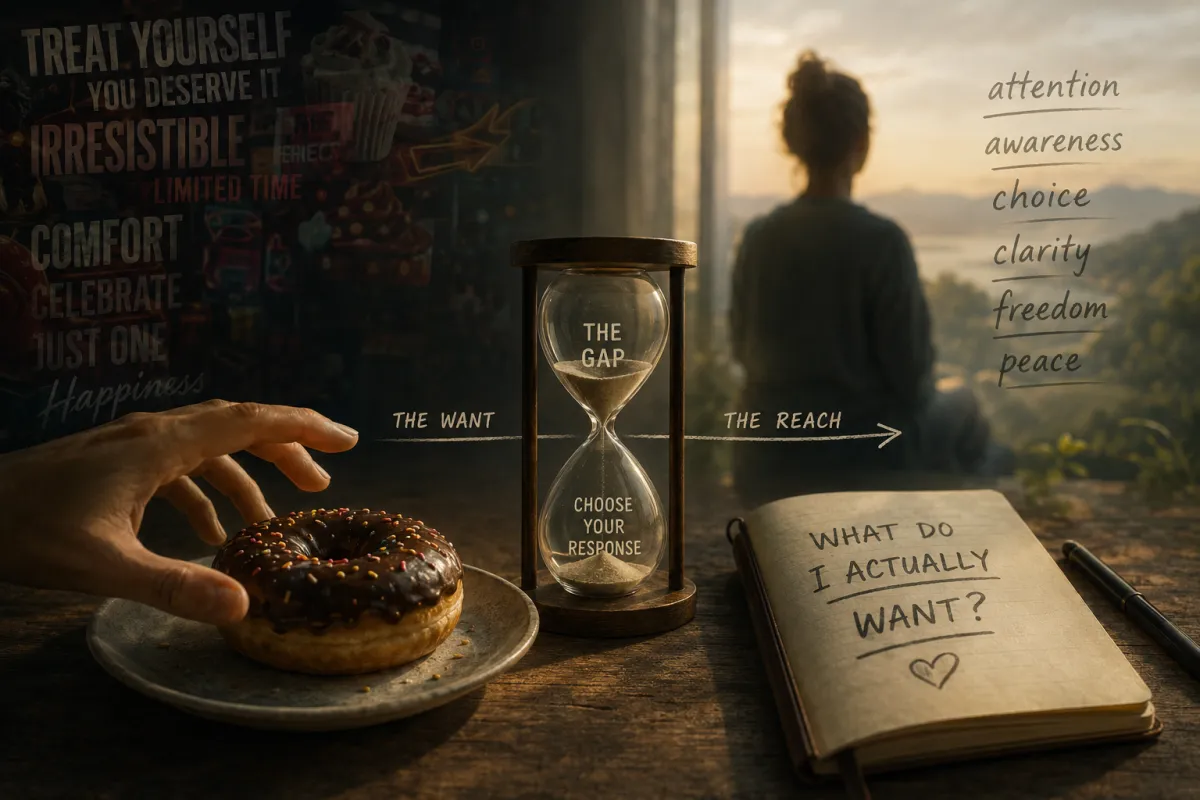
A craving arrives, demands something, and most of the time we just comply. We don’t examine it. We don’t ask where it came from. We eat the thing, the craving quiets, and we move on having learned nothing about ourselves except that we’re “bad at willpower.” But in the process of becoming aware enough to see the pull for what it is (usually part physiological and part emotional), you cultivate a space, a half-second between the want and the reach. And in that gap, something interesting happens: you get to watch the wanting instead of just obeying it.
That gap is the whole point of this piece.
I’ve spent years writing about the biology of sugar dependency — the dopamine, the blood sugar swings, the gut bacteria, the engineered food environment. All real, all worth understanding. But underneath the biology, I started noticing something more personal: every time I caught a craving instead of just acting on it, I learned a little more about which parts of my wanting were actually mine, and which parts I’d absorbed from somewhere else — an ad, a culture, a story about what celebration or comfort is supposed to look like.
Here are ten ways that noticing has shaped me, beyond the physical.
1. It trains attention. A craving is loud on purpose — it’s built to bypass thought and go straight to action. The first skill quitting sugar teaches you is just noticing the craving as it’s happening, instead of being fully inside it. That’s a small thing. It’s also the foundation of every contemplative tradition that’s ever existed: the capacity to observe your own mind instead of being run by it.
2. It strengthens the muscle of delay. Psychologist Walter Mischel’s marshmallow studies are famous mostly for their follow-up data — kids who could wait for a second marshmallow tended to do better, decades later, on measures of life outcomes. The interesting part isn’t the willpower itself. It’s what delay makes possible: a sliver of space between impulse and action, long enough to ask whether this is actually what you want, or just what’s loudest right now.
3. It exposes how much of “you” is borrowed. Somewhere along the way, a lot of us picked up a self that includes phrases like “I’m a chocolate person” or “I can’t say no to dessert.” Those aren’t facts about your nature. They’re sentences you adopted, usually because food marketing and food culture handed them to you early and often. Letting go of a craving you’ve called part of your identity is uncomfortable in a specific way — it asks you to find out who you are without that sentence.
4. It’s a daily exercise in choosing. Every craving, or simple desire for something sweet after dinner, is a small fork in the road: follow the impulse, or don’t. Most days that fork feels trivial. But the nervous system doesn’t know the difference between a trivial choice and an important one — it just knows whether you followed through on an intention or didn’t. Practiced enough times, in a low-stakes arena like sugar, that follow-through becomes available in higher-stakes places too.
5. It frees up energy you didn’t know you were spending. Wanting takes energy — the planning, the negotiating with yourself, the mental real estate a desire or craving occupies before you’ve even acted on it. Researchers who study self-regulation describe this as a real cognitive cost, not a metaphor. When you stop spending energy on resisting cravings, it becomes available for other things, including the people and work you actually care about.
6. It teaches the difference between control and disinterest. For a long time I thought quitting sugar meant getting better at resisting it. White-knuckling through the craving with willpower. That’s exhausting, and it doesn’t last — the restriction-rebound cycle is well documented in eating research for a reason. What actually changed things was different: not fighting the craving harder, but losing interest in it. Control spends energy. Disinterest doesn’t ask anything of you at all. That shift — from gritted teeth to genuine indifference — is maybe the most spiritually interesting part of the whole process, and it is a taste of freedom.
7. It clarifies what’s actually satisfying. Sugar delivers fast relief and then asks for more. That’s not a flaw in your character; it’s how the reward system is built — pleasure that fades quickly creates pursuit, not satisfaction (researchers like Kent Berridge have spent careers mapping exactly this gap between “wanting” and “liking”). Watching that pattern up close, repeatedly, makes it easier to recognize the same shape elsewhere: in scrolling, in shopping, in any pursuit that promises arrival and delivers another lap. You start to notice which things actually land, and which just reset the loop.
8. It’s a low-stakes place to practice a high-stakes skill. Unlike the big disappointments or losses in life, which don’t come around often enough to practice for, a craving or desire for something sweet comes around fifteen times a day. It’s a sandbox. Practicing presence and non-reactivity with a cookie is, oddly, training for the moments that actually matter.
9. The body gets quieter, and quiet is where the rest happens. This part is physical, and worth naming plainly rather than dressing up. Diets high in added sugar and refined carbohydrates are linked to chronic low-grade inflammation, partly through a process called glycation, where excess sugar binds to proteins and fats and creates compounds that drive oxidative stress in the body.¹ For some people that shows up as brain fog, joint aches, skin issues, or restless sleep — background noise that’s easy to mistake for just how things are. When that noise quiets down, it’s easier to notice everything else: your thoughts, your actual desires, the difference between stimulation and peace.
10. It’s an investment in having more time, clear-headed, in this body. Insulin resistance — the long-term result of repeated blood sugar spikes — has a well-documented relationship with cardiovascular disease, and a growing body of research links it to cognitive decline and dementia risk as well, sometimes informally called “type 3 diabetes” in the research literature.² That term isn’t an official diagnosis, and the field is still working out exact mechanisms. But the association between metabolic health and brain health is real enough that it’s worth taking seriously. However you think about what happens after this life, it seems worth having a clear mind and a working body for as much of this one as possible.
A few caveats, because I’d rather state them than have you wonder.
This isn’t a case for moralizing food. Sugar isn’t evil and eating it isn’t a failure of character — I’ve written elsewhere, and believe firmly, that cravings are signals from a stressed or under-resourced system, not proof of weak will. Two things are true at once: cravings deserve curiosity and compassion, and sugar has measurable effects on the body that are worth understanding clearly. Holding both is the point, not a contradiction to resolve.
This also isn’t a claim that abstinence is the only path, spiritually or otherwise. It’s just the path I’ve walked, and the lab I happened to run the experiment in. The actual claim is smaller and, I think, more useful: any consistent practice of noticing a craving instead of obeying it — sugar, scrolling, shopping, whatever yours is — will teach you something about which parts of your wanting are yours.
If any of this is landing — the gap between the want and the reach, the question of what’s actually yours — I want to invite you to go deeper with it.
On July 15th at 7pm ET, I’m hosting a free live session called Why You Keep Going Back to Sugar Even When You Don’t Want To. It’s for anyone who’s said some version of I know better, I just can’t seem to stop — and wants to actually understand why, instead of trying to white-knuckle through it again.
We’ll get into the biology (dopamine, blood sugar, the systems working underneath your willpower) and the deeper pattern this piece started to point at: how a craving can feel urgent and automatic while having very little to do with what you actually want.
Info and register here:
https://createchangelab.com/why-you-keep-going-back-to-sugar


© 2025 Create Change Lab, LLC and Andrea Grayson. All Rights Reserved,